



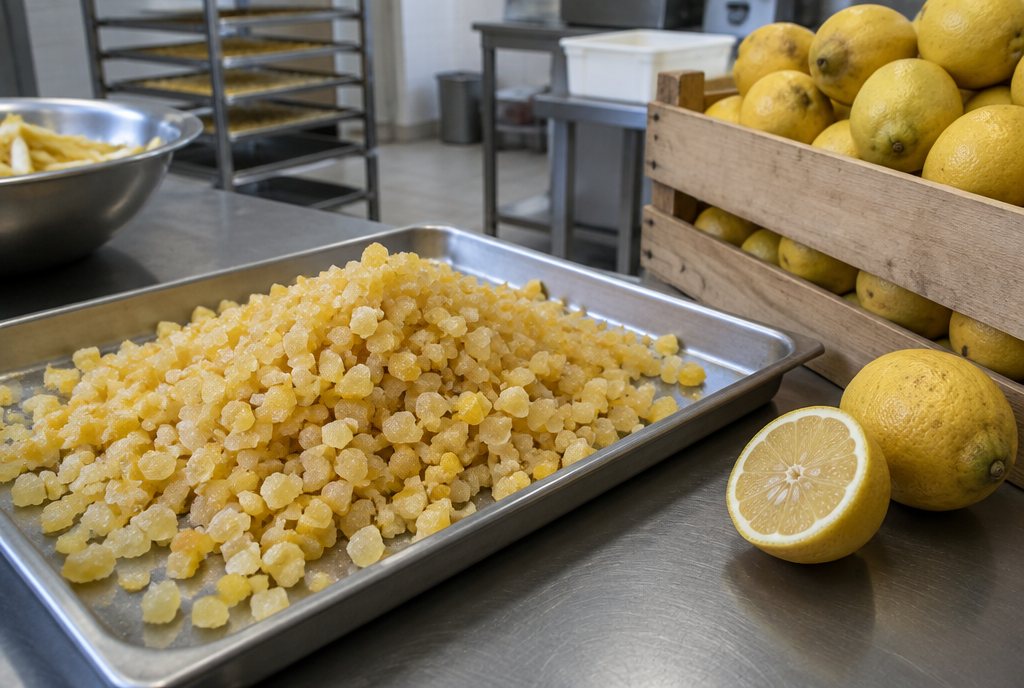
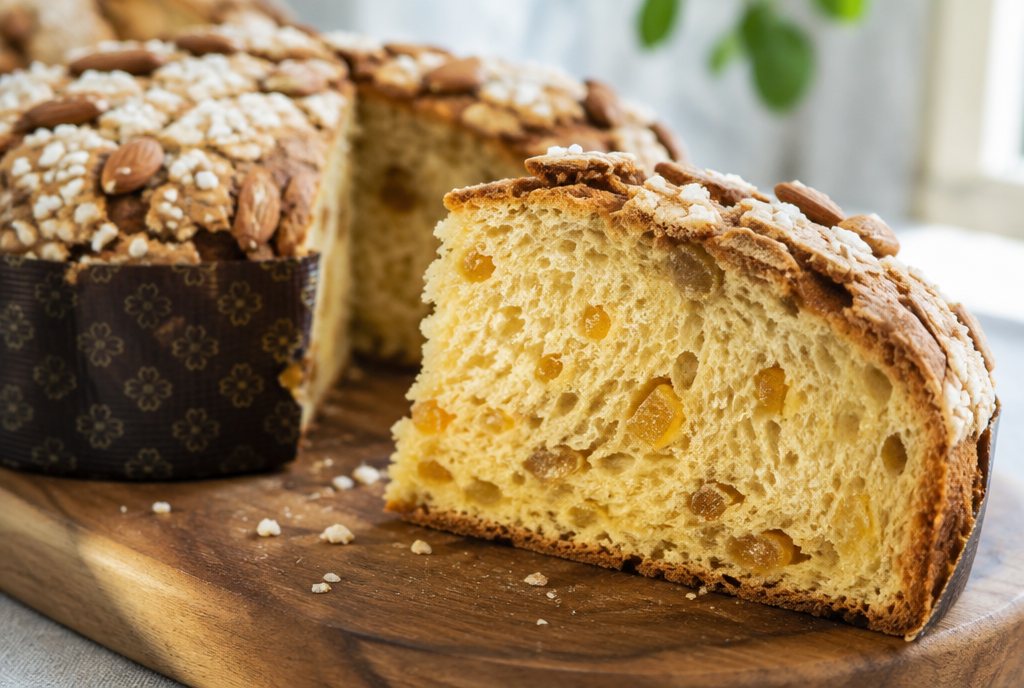
In panettone, colomba or a loaf cake, a few cubes of candied lemon are enough to change the aromatic profile: fresher and livelier than orange. For candied-fruit makers and industrial bakeries, quality starts with the raw material: diced lemon peel must be regular, well sorted and preserved so that it reaches the candying line with its colour and aroma intact. And it should not be confused with citron.
Lemon peel vs orange peel: what changes in production
The basics of candying are the same as those described in our article on orange cubes in SO₂ for candied fruit. With lemon, three things change:
- Thickness: lemon peel is generally thinner than Navel orange peel. Each cube has less body: pieces that are too small can fall apart or harden during candying.
- A more bitter albedo: the white layer of a lemon has a sharper bitter note, and the ratio between flavedo (the yellow outer layer) and albedo directly shapes the taste of the candied peel.
- Aroma: lemon essential oils have a fresh, zesty profile linked to citral: it comes through even at low doses, but suffers from overly aggressive processing.
Candied lemon peel or candied citron? Two different fruits
Citron (Citrus medica) is a classic of Italian pastry, often blended with orange in traditional panettone. The two names sometimes get mixed up in specifications, not least because languages are misleading: in English “citron” is Citrus medica, while in French “citron” means lemon. Citron has a very thick peel, made almost entirely of firm albedo, and gives fleshy cubes with a full bite. Lemon gives thinner cubes with an unmistakable scent and a slight bitter edge that balances very sweet doughs.
Citron for structure and chew, lemon for recognisable freshness; many producers use both. In the UK, “mixed peel” often combines orange and lemon. What matters is that the label matches the fruit actually used: state it clearly in your order and data sheet.
In SO₂ or frozen: which format to choose
- In SO₂: the classic choice for candied-fruit plants. The cubes stay stable in drums at ambient temperature and are candied whenever needed. First they must be desulphited: washing and blanching bring sulphites back within limits and help soften the albedo and tone down its bitterness. Sulphur dioxide (E220) is an additive regulated in the EU by Regulation (EC) No 1333/2008.
- Frozen at −18 °C: for those who want to skip desulphiting, to candy with their own process or to use directly in doughs, creams and fillings.
Diced lemon peel: cube size and tolerance in the data sheet
Before supply, agree a few parameters (see our guide on how to read the specifications of semi-processed fruit):
- cube size and tolerance for off-size pieces and fragments;
- amount of albedo and residual pulp;
- peel colour and absence of blemishes;
- for product in SO₂, SO₂ content of the solution and packaging;
- origin and batch traceability.
On origin, read our comparison of Calabrian and imported lemons: here the peel is the ingredient. Our Calabrian lemons are processed in San Ferdinando, a few kilometres from the groves.
Applications and pairings
- Festive leavened cakes: panettone, colomba and pandolce, on their own or with orange (see also orange peel for panettone and colomba).
- Loaf cakes and baked cakes: freshness in butter-rich batters.
- Biscuits and dry pastry: shortbread, cantucci, almond sweets.
- Pairings: almond, pistachio, white chocolate, ginger, ricotta.
Frequently asked questions
Can I replace citron with lemon in the same recipe?
Yes, but the result will change: lemon brings more aroma and a bitter note, citron more structure. Run dosage trials and update the ingredient list.
Do lemon cubes in SO₂ always need desulphiting?
Yes, they are an industrial semi-finished ingredient. In the EU, sulphites above 10 mg/kg in the finished product, expressed as SO₂, must be declared on the label as an allergen (Regulation (EU) No 1169/2011).
Do you process other lemon cuts?
Yes: slices, wedges, strips and fine julienne, in SO₂ or frozen at −18 °C. Tell us the cut and the final use.
Need this ingredient for your production?
Tell us product, cut, preservation method and volumes: we’ll reply with the technical data sheet and a tailored quote.