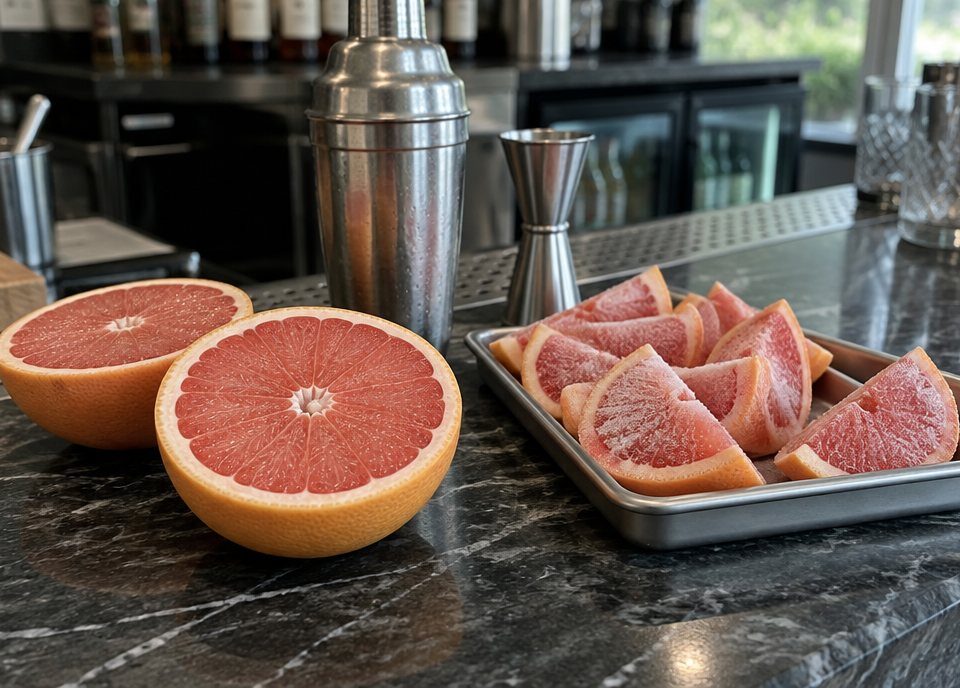





Every candied-fruit maker knows it: the final result depends more on the raw material than on the syrup. An irregular orange cube, with too much flesh or a thin peel, absorbs sugar unevenly, breaks during processing and ends up dull. That is why many manufacturers start from orange cubes preserved in SO₂: fruit that is already selected, cut and stabilised, ready to be desulphited and candied whenever needed, even out of season.
Why start from orange cubes in SO₂
Sulphur dioxide (SO₂) stops oxidation and fermentation, so the cubes keep their colour, aroma and texture for months without a cold chain. For a candied-fruit plant this means three practical advantages:
- Planning: the citrus harvest lasts a few months, candied-fruit production runs all year. With fruit in SO₂ you stock up during the season and process when orders come in.
- Consistent yield: the fruit is already cut into even pieces. Less waste, predictable candying times.
- Simple logistics: fruit in SO₂ travels and is stored in food-grade drums or tanks at ambient temperature.
The right orange: variety and origin
For candying, the peel is what matters most: it must be thick, firm and aromatic. Calabrian Navel oranges have a peel rich in essential oils and a generous albedo (the white layer), which becomes soft and translucent when candied. Sourcing from Calabria means a short, traceable supply chain: we process the citrus a few kilometres from the groves, at our plant in San Ferdinando.
How they are processed: from harvest to drum
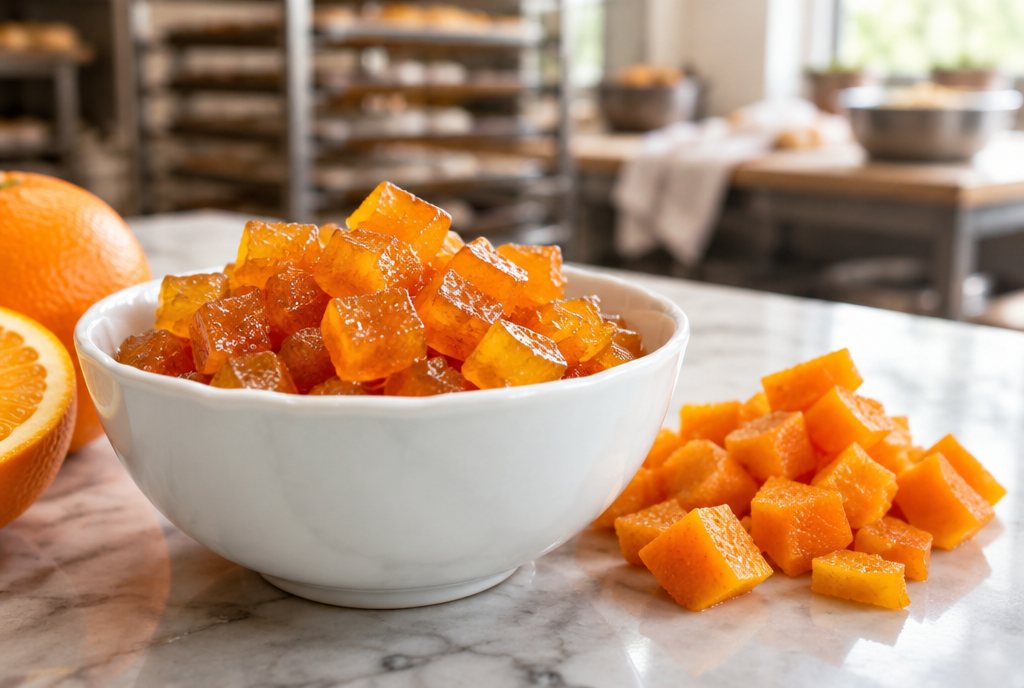
The oranges are sorted, washed and diced to the requested size; the cubes are then placed in an SO₂ solution and packed in drums or tanks. It is a semi-processed product: not intended for direct consumption but for industrial processing.
Before candying, the cubes must be desulphited — washed and blanched to remove the sulphur dioxide down to permitted levels. Then come the classic steps: syrups of increasing concentration, draining, optional glazing. Every plant has its own protocol, which is why the raw material must be consistent from batch to batch.
Applications: where candied orange cubes end up
- Festive leavened cakes: panettone, colomba and similar.
- Biscuits and dry pastry: cantucci, shortbread, cassata.
- Ice cream and semifreddo: as inclusions or decoration.
- Chocolate: bars, pralines and citrus snacks.
What to ask for in the technical data sheet
Before the first order, agree a few parameters with your supplier. We cover this in detail in our guide on how to read the specifications of semi-processed fruit; for orange cubes in SO₂ the key points are:
- Cube size and accepted tolerance;
- SO₂ content of the preserving solution;
- Peel-to-flesh ratio and presence of seeds or fibres;
- Packaging (drum or tank) and net weight;
- Traceability of the batch back to the grove.
Exact values and tolerances are stated in the technical data sheet of each batch, agreed with the customer according to the final use.
Frequently asked questions
Can orange cubes in SO₂ be used without desulphiting?
No. They are an industrial semi-finished ingredient: before food use they must be desulphited to bring residual sulphites within legal limits. Remember that in the EU, sulphites above 10 mg/kg in the finished product must be declared on the label as an allergen.
How long do orange cubes in SO₂ keep?
Stored correctly in closed drums, they keep their characteristics for many months — which is exactly what allows candying all year round. The indicative shelf life is given in the data sheet.
Are other cuts available?
Yes. Besides cubes we process oranges into segments, strips, slices, quarters and fine julienne, both in SO₂ and frozen at −18 °C.
Need this ingredient for your production?
Tell us product, cut, preservation method and volumes: we’ll reply with the technical data sheet and a tailored quote.