



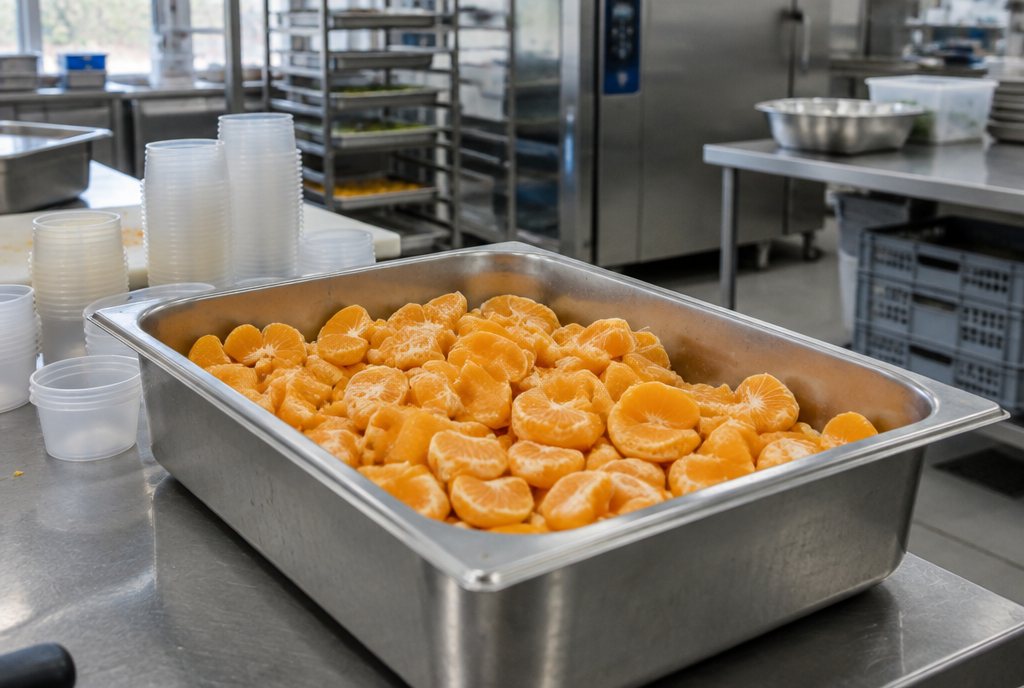
In central kitchens cooking for schools, hospitals and workplaces, peeling oranges by hand is a job few can afford. Yet fruit has to be on the menu every day. Ready-to-use orange segments for catering solve the problem: oranges already peeled and segmented, frozen at −18 °C, to be thawed and served with no further preparation.
Ready-to-use orange segments for catering: why they work
- No peeling labour: staff no longer spend time peeling and segmenting citrus and can focus on the meals.
- Consistent portions: segments are easy to weigh and portion, so the portion sizes set in the menu are met on every tray.
- Less waste: no peel to dispose of in the kitchen and no fruit spoiling in storage.
- Easier to eat: in school canteens a whole orange often comes back untouched because peeling it is awkward; a ready segment gets eaten.
- Oranges on the menu all year: even after the citrus season has ended.
One detail matters a lot in the kitchen: the freezing method. With loose-frozen product you take exactly the quantity you need; with a block you thaw the whole pack. We cover this in our article on loose and block freezing.
Hygiene and food safety
Every handling step is a point to control in the HACCP plan: washing the fruit, knives, chopping boards, surfaces. With segments already peeled, these steps are reduced in the kitchen: the product arrives packed, labelled and identified by batch. This also counts in catering tenders, where supply chain traceability, from grove to pack, is increasingly requested.

Thawing and handling in the kitchen
- plan thawing in advance, in the fridge or a chiller, never at room temperature;
- keep segments in closed containers labelled with the thawing date;
- portion with clean, dedicated utensils shortly before service;
- serve the same day, according to your internal procedures;
- never refreeze thawed product.
Once thawed, segments are softer than fresh fruit, so they work best in fruit cups, fruit salads and desserts. For industrial use in yogurt and desserts, see our article on frozen orange segments for yogurt and desserts.
How to use them on the menu
- Single-portion fruit cups for school and hospital trays;
- Fruit and mixed salads: from the classic orange and fennel salad to salads with nuts;
- Desserts: panna cotta, tarts, puddings, yogurt at the buffet;
- Breakfast buffets in hotels and airline catering, alongside yogurt and cereals. For fresh juices and smoothies, use frozen orange quarters instead.
What to specify in your quote request
- Pack format: packs sized to one service, so you don’t thaw more than you need;
- Piece size: whole segments or pieces, with or without membrane;
- Loose or block frozen (see above);
- Volumes, taking into account the school calendar or the tourist season;
- Delivery frequency you need, based on your freezer space;
- Documents: data sheet, labelling, batch traceability.
The starting fruit is our Calabrian Navel oranges, typically seedless — an important detail when the fruit is for children.
Frequently asked questions
Do they contain preservatives?
No: preservation relies on freezing at −18 °C. The product composition is in any case stated in the data sheet.
Are SO₂ orange segments suitable for kitchens?
SO₂ segments are an industrial semi-processed product that must be desulphited before use, so they are not meant for direct service. For canteens and catering, frozen is the right choice.
What quantities do I need to start?
It depends on the format: tell us how many meals you prepare and how often oranges are on the menu, and we’ll propose the best solution.
Need this ingredient for your production?
Tell us product, cut, preservation method and volumes: we’ll reply with the technical data sheet and a tailored quote.