



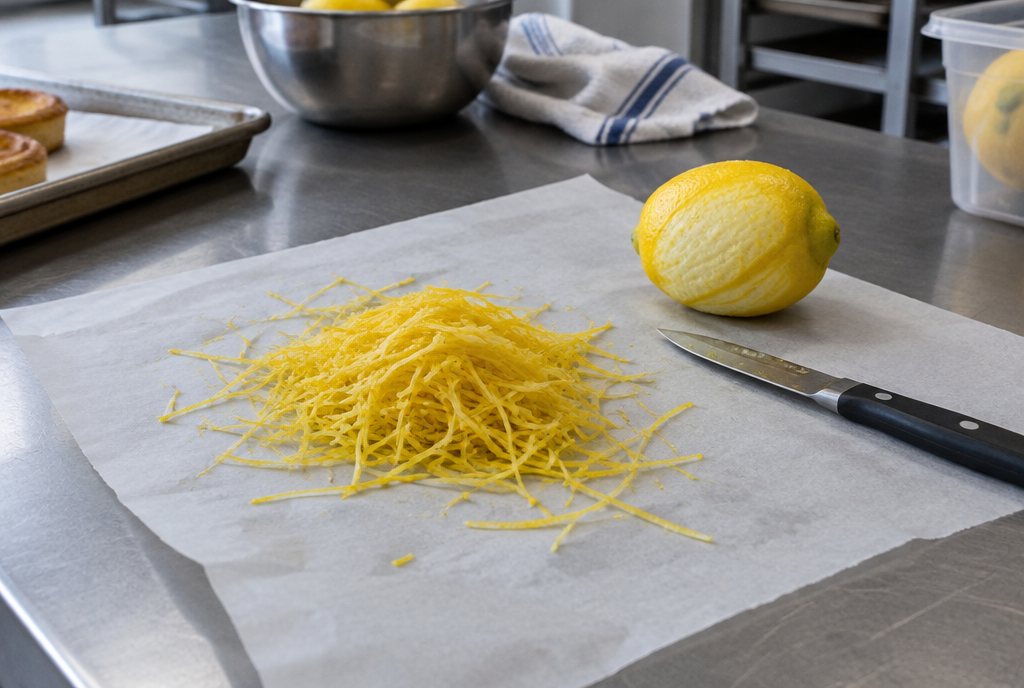
On a lemon tart or a semifreddo, a tuft of candied lemon peel julienne tells customers at a glance what they are about to taste. Italians call these extremely fine strands capelli d’angelo, “angel hair”: they are used candied for decoration, or plain to flavour creams and bases. But a lemon is not just a smaller orange, and its peel needs its own approach.
Why lemon peel is different
Compared with orange, lemon has a thinner peel and a more bitter albedo, the white layer. In orange peel julienne a little albedo supports the strand; in lemon the same white layer is immediately noticeable and can mask the fresh aroma of the zest. That is why the cut must be precise and keep mainly the flavedo — the yellow outer layer that holds the essential-oil glands — with only as much albedo as is needed to hold the strip together.
Lemon peel julienne: in SO₂ or frozen?
- In SO₂: for those who candy in-house. The strands are stored in drums and must be desulphited before use, by washing and boiling in water, then candied in syrup. Sulphur dioxide prevents browning but tends to lighten the peel. Remember that sulphites are allergens: above 10 mg/kg, expressed as SO₂, they must be declared on the label (Regulation (EU) 1169/2011).
- Frozen at −18 °C: for those who want fresh peel without additives, with a colour closer to the fruit. Suitable for infusing milk and cream for semifreddo and panna cotta, or for a short candying process in the lab.

Colour: protecting the yellow
Yellow is the visual signature of lemon julienne. It depends first on the raw material — well-coloured fruit with sound peel — and then on preservation and candying. The expected colour, for both SO₂ and frozen product, is described in the data sheet.
Where it is used
- Lemon tarts: on the cream or meringue, in the centre or along the edge.
- Cheesecake: candied strands lift the cream cheese with a fresh, tangy note.
- Semifreddo and panna cotta: frozen julienne infused in the base, candied julienne as decoration.
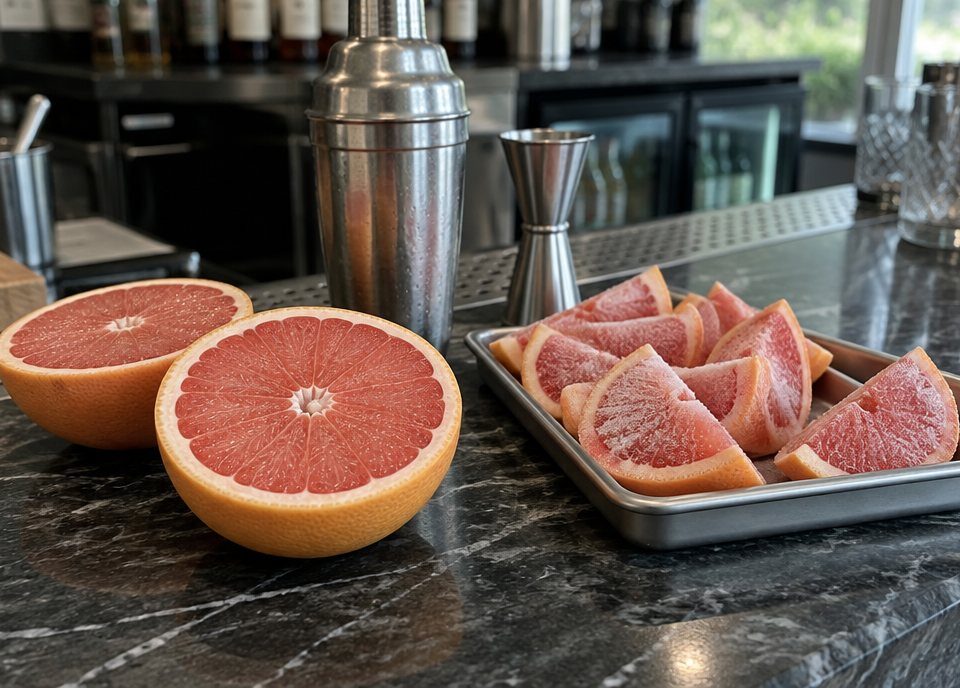
- Cocktails: candied and dried, as a garnish for citrus drinks.
Storage after candying
Because it is so thin, candied julienne is more exposed than larger cuts: keep it in closed containers, away from light and heat, which dull the yellow over time, and from humidity, which makes it sticky. Many labs store it in its own syrup and drain it just before decorating. Times and conditions depend on the candying recipe and should be validated in-house.
What to specify in your request
- width and length of the strands, agreed in the data sheet;
- albedo allowed;
- version: for candying (in SO₂ or frozen) or already candied;
- packaging and seasonal and annual volumes;
- information on post-harvest treatments of the fruit, which matter whenever the peel is used.
We process Calabrian lemons in San Ferdinando. To compare formats, read our guide to frozen fruit cuts and the one on how to read the data sheet of semi-processed fruit.
Frequently asked questions
What is the difference between lemon julienne and citron peel?
Citron has a much thicker peel with abundant, mildly bitter albedo, and is the classic candied fruit in cubes or slices. Lemon gives thin strands and a fresher, tangier aroma, ideal for decoration.
Does lemon julienne break more easily than orange julienne?
Being thinner and with less albedo, it is more delicate: a regular cut (which also helps even candying), careful handling during desulphiting and candying, and packaging that does not crush it all matter.
Can it be used without candying?
Yes: the frozen version is used to flavour creams, infusions and bases. For visible decoration, candied julienne is usually preferred as it is glossier and softer.
Need this ingredient for your production?
Tell us product, cut, preservation method and volumes: we’ll reply with the technical data sheet and a tailored quote.