



A lemon wheel on a tart, a lemon cake or the rim of a glass is recognisable at a glance: bright yellow, radiating segments, a thin ring of peel. Buyers sourcing lemon slices for decoration at industrial scale know, however, that lemon does not behave like orange: it is more acidic, its white pith is more bitter and a thin slice needs careful handling. Lemon slices in SO₂ are the semi-processed product that industrial bakeries, candied fruit makers and beverage suppliers start from to get consistent decorations all year round.
What SO₂ lemon slices are
They are cross-sections of whole Calabrian lemon, peel and flesh, preserved in a sulphur dioxide solution (E220, an additive regulated by Regulation (EC) No 1333/2008). SO₂ stabilises the fruit and protects its structure, so candying or drying can be scheduled when needed, not only during harvest. The principle is the same as for orange slices in SO₂, covered in a dedicated article: here we focus on what changes with lemon.
Lemon slices for decoration: how they differ from orange
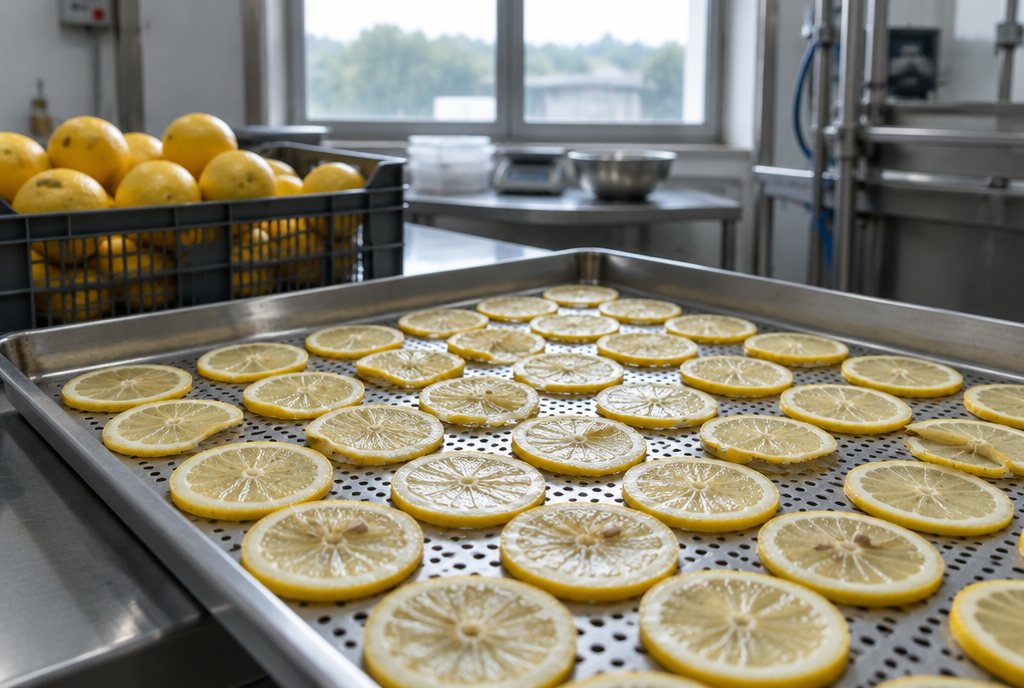
- Appearance: a lemon cross-section shows well-defined segments and, once candied, can turn almost translucent — the “stained glass” effect sought on cakes and tartlets.
- Bitter pith: lemon albedo is more bitter than orange albedo, so washing, any blanching and candying must be carefully calibrated.
- High acidity: the very acidic flesh balances the sugar and adds freshness, but must be taken into account when setting up the syrup and recipe.
- Seeds: unlike Navel oranges, lemons may contain seeds; the tolerance is agreed in the data sheet.
A lemon slice should not be confused with candied citron: citron has a very thick albedo and is mostly used diced, while the lemon slice is thin, with visible flesh and a tangier taste.

Uses in bakery and beverages
- Lemon cakes and tarts: whole candied slices arranged in a ring, or half-moons around tartlets and cheesecakes.
- Leavened cakes and loaf cakes: surface decoration according to the bakery’s recipe.
- Candied fruit producers: candied slices for pastry shops and ice-cream parlours, also glazed.
- Beverages and mixology: once candied or dried, they become garnishes for cocktails, iced teas and lemonades. For a ready-dry product, see our article on dried citrus slices.
Desulphiting and sulphite labelling
SO₂ slices are not used as they are: they must first be desulphited through washing and cooking, according to the user’s process, then candied or dried. A general reminder: under Regulation (EU) No 1169/2011, sulphites are allergens that must be declared on the label when they exceed 10 mg/kg or 10 mg/l expressed as SO₂ in the product as ready for consumption. Checking the residue in the finished product is the responsibility of whoever places it on the market.
What to specify in your request for quotation
- slice thickness and tolerances, to be set in the data sheet;
- tolerances for broken or incomplete slices, end pieces and seeds;
- end use: candying, drying, whole or halved decoration;
- packaging format, annual volumes and any seasonal peaks.
Our guide to technical specifications for semi-processed fruit explains how to read these parameters.
Frequently asked questions
Can I put SO₂ slices straight into a cocktail?
No. They are a semi-processed product: they must be desulphited and then candied or dried. Only the finished product becomes a garnish.
Are candied lemon slices bitter?
Lemon pith is naturally bitter, but well-calibrated desulphiting, blanching and candying bring it into balance with acidity and sugar. Fine-tuning depends on each producer’s recipe.
Candied or dried: which is better for bars?
Candied slices are soft and glossy, ideal for sweet drinks and desserts in a glass; dried slices are light and dry, easy to keep at the bar.
Need this ingredient for your production?
Tell us product, cut, preservation method and volumes: we’ll reply with the technical data sheet and a tailored quote.