



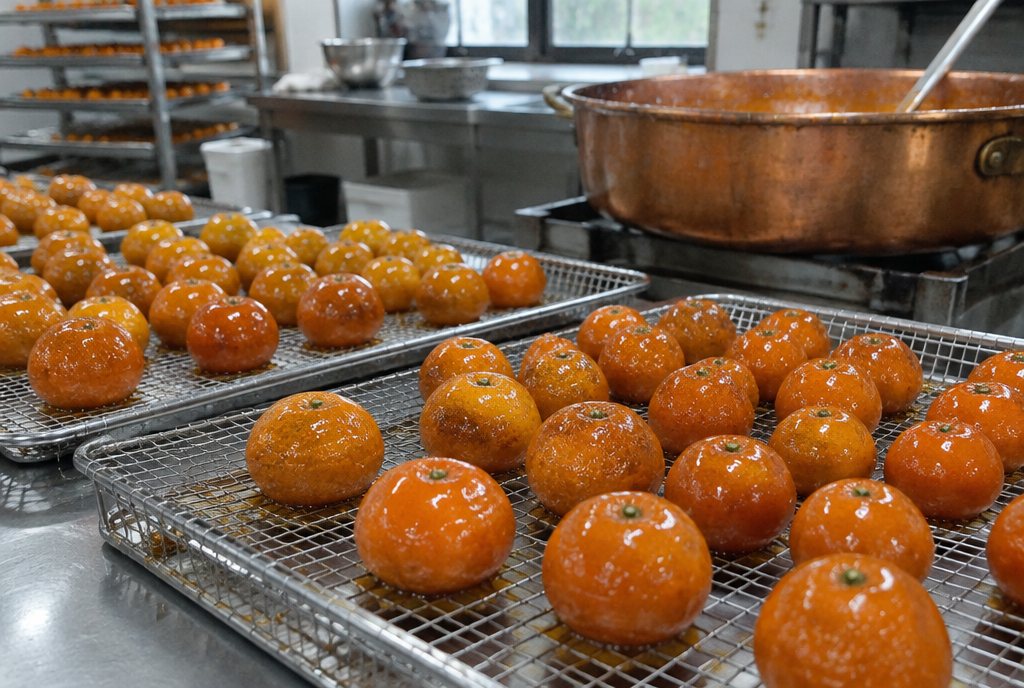
A whole candied clementine is one of the most striking pieces in candied fruit: it sells in gift boxes, it can be glazed or dipped in chocolate, and it decorates traditional desserts such as Sicilian cassata. It is also one of the hardest to make, because the syrup has to reach the centre of a fruit still sealed in its peel. For a candied fruit maker, the quality of whole candied clementines is therefore decided before candying begins: in the choice of fruit and in how it has been preserved.
Why clementines are candied whole
The clementine has the right features for whole-fruit candying: small size, thin smooth peel and flesh that is often seedless. Unlike oranges, usually candied as cubes, strips or slices, a whole clementine gives a product that is recognisable at a glance, with peel and segments held together.
Why start from whole clementines in SO₂
Clementines are harvested over a few months between autumn and winter (see our Calabrian citrus calendar), while a candying plant works all year and prepares seasonal campaigns well in advance. SO₂ preservation bridges that gap: the fruit is bought in season, kept in closed drums at ambient temperature and candied as orders come in. Sulphur dioxide (E220, an additive regulated by Regulation (EC) No 1333/2008) slows oxidation and fermentation and keeps the fruit’s structure. That is why we supply our whole clementines in SO₂ only: it is the preservation method designed for candying, syrups and confectionery preparations.
From drum to candying: what changes with whole fruit
The stages are those of any candying process, described in our article on candied orange, in-house or from semi-processed fruit. With whole fruit, however, every step needs more care:
- Slower desulphiting: a whole fruit exposes less surface than a cube, so washes and hot-water stages must be longer or repeated. Validate the protocol on your own plant.
- Opening the peel: many protocols include pricking the peel to help the syrup enter the fruit.
- Gradual sugar: the syrup must replace the water right to the centre. If concentration rises too quickly, the peel hardens and shrivels while the core stays under-candied.
- Gentle handling: moving between tanks and syrups, whole fruits bruise and split more easily than pieces.

How to recognise good whole candied clementines
- Intact shape: round fruit, no splits, flattening or detached peel.
- Even candying: cut in half, the inside is translucent and uniform, with no opaque core.
- Soft, glossy peel: neither hard nor shrivelled.
- Consistent size: fruits of similar size candy at the same pace and pack better.
Most of these results depend on the semi-processed fruit: a clementine that is already bruised or damaged in the drum will hardly become a good whole candied fruit.
What to specify in your request for quotation
- end use: whole candied fruit, glazed, chocolate-coated, decoration;
- size range and tolerance for off-size fruit;
- accepted defects: split, bruised or damaged-peel fruit;
- packaging, net weight per unit, annual volumes and collection schedule;
- documents: data sheet, batch traceability, information on the preserving solution.
To read the parameters, see our guide to technical specifications of semi-processed fruit; on the fruit itself, read our article on clementines.
Frequently asked questions
Do clementines in SO₂ always need desulphiting?
Yes. They are an industrial semi-processed product, not ready to eat. In the finished product, sulphites above 10 mg/kg or 10 mg/l, expressed as SO₂, must be declared on the label as an allergen (Regulation (EU) No 1169/2011): the producer checks the residue by analysing its own batches.
Do you supply clementine segments or frozen clementines?
No, we process clementines whole and in SO₂ only. For cut citrus, in SO₂ or frozen at −18 °C, look at our oranges, lemons, mandarins and pink grapefruit.
Can the same clementines be used for fruit in syrup?
Yes: after desulphiting the process changes, not the semi-processed fruit.
Need this ingredient for your production?
Tell us product, cut, preservation method and volumes: we’ll reply with the technical data sheet and a tailored quote.