


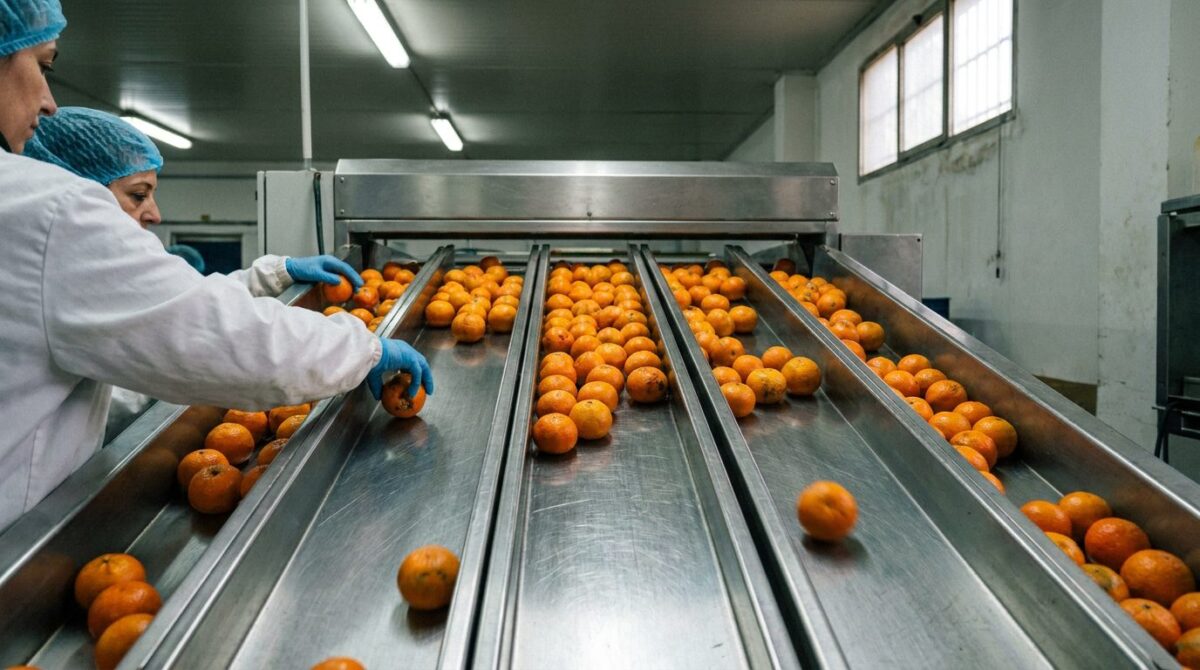
Clementine is one of the most requested citrus fruits in the European food industry. Seedless, sweet, easy to peel, rich in vitamin C, with high juice yield: it has all the characteristics that an industrial buyer looks for for yogurt, ice cream, baby food, preserves and drinks.
Main industrial varieties
The most common varieties in the Italian semi-processed products market:
- Common: the historical variety, medium size (60-70 mm), good sweetness, flowering October-December.
- Hernandina: late (January-March), caliber 65-75 mm, high Brix.
- Nothing: early (September-November), large caliber, excellent yield.
- Marisol: very early (September), for the “first fruits” segment.
- Orogrosso: late Calabrian, high Brix 13-15.
Industrial calibers
The calibers are the first variable that the buyer must specify. For clementines intended for industry:
- Caliber 1 (XL): 64-78 mm — used for whole decorative frozen foods.
- Caliber 2 (L): 58-69 mm — standard for wedges and cubes.
- Caliber 3 (M): 50-60 mm — the most requested for pulps and juices.
- Caliber 4 (S): 46-56 mm — intended for by-products, essential oils, industrial juices.
- Caliber 5 (XS): 43-52 mm — heavy industry fruit.
Smaller sizes do not mean lower quality: small clementines often have higher Brix and are perfect for industrial juicing.
Processing formats
Whole frozen clementines.Peeled or with peel, frozen individually. Used by industrial pastry shops for decorative cakes and tarts, by ice cream parlors for visual inserts.
Frozen segments (segments).Raw peeled, without membrane, individually frozen. The most requested format for premium yogurt, mousse, fruit mascarpone. Yield: approximately 65-70% of the whole fruit weight.
Cubes.Available in 6×6, 8×8, 10×10 mm. For fillings, ice creams, fruit ricottas. They must maintain shape to avoid releasing juice into the final product.
Filtered and unfiltered pulp.For the juice, syrup and artisanal ice cream industry. The unfiltered pulp retains fibers (1-3 mm) perceptible on the palate.
Concentrated juice65 °Bx. Used in beverage and industrial aromatic shops.
Typical organoleptic specifications
For Calabrian clementines intended for the yogurt and ice cream industry, the reference parameters:
- Brix: 11-14 °Bx
- Total acidity: 0.8-1.2 g/100 mL as citric acid
- E/A ratio: 13-17
- Juice yield: 45-55%
- Vitamin C: 30-45 mg/100 g
Typical industrial applications
Clementine yogurt.Individually frozen segments dosed at 8-12% of the total weight of the jar, on a fermented milk preparation at 4.3 pH.
Industrial artisanal ice cream.25-35% pulp, mixed with sorbet base mixture, to obtain the characteristic light orange color and fresh aromatic profile.
Baby food.Pulp filtered 1 mm, homogenized, pasteurized. Often mixed with pear or apple pulp to sweeten.
Extra jams and compotes.Whole segments in Brix 65 syrup, for “premium spread” consumption.
Non-alcoholic drinks.Cloudy juice at 25-50% of the finished product, for premium soft drinks and RTDs.
Seasonality
Calabrian clementines are available from September (early) to March (late). Prices of fresh raw materials reach their minimums in November-December, the ideal period for planning industrial processing and frozen storage.
See our whole clementinesCalabrian in the various calibers and industrial cuts available.


