




Mandarin is the most fragrant citrus fruit you can put in a jar, and one of the trickiest to cook: sweet, low in acid, with a thin peel and often plenty of seeds. Anyone sourcing mandarins for marmalade and extra jam has to settle three questions before the recipe: what to call the product, how to get a good set and which format to buy the fruit in.
Mandarin marmalade or mandarin jam?
In the European Union the name marmalade is reserved for citrus fruit: Directive 2001/113/EC, as amended by Directive (EU) 2024/1438, now refers to “citrus marmalade”. Mandarin is a citrus fruit, so “mandarin marmalade” is correct. What changes are the permitted ingredients: marmalade is made from citrus pulp, purée, juice, aqueous extracts and peel; jam and extra jam start from pulp or purée, and citrus jam may also use the whole fruit cut into strips or slices. For minimum fruit content, see our article on oranges for industrial marmalade; for labelling, the consolidated text and national rules prevail.
Why mandarins for marmalade are a demanding fruit
- Low acidity: conventional pectin sets in an acidic, sugar-rich environment. With a sweet fruit like mandarin, acidity is often corrected with lemon juice or citric acid, depending on the Brix and acidity of the batch (see our guide to Brix and acidity of Calabrian citrus).
- Thin peel: compared with bitter orange, mandarin has little albedo, the white, pectin-rich layer, so many recipes call for added pectin.
- Volatile aroma: the essential oils in the peel are the real value of the product, but long boiling drives them off. That is why industry prefers short cooking or vacuum concentration at lower temperatures.
- Seeds: the common mandarin often has many, and if they break they can add bitter notes. The tolerance should be set in the data sheet.
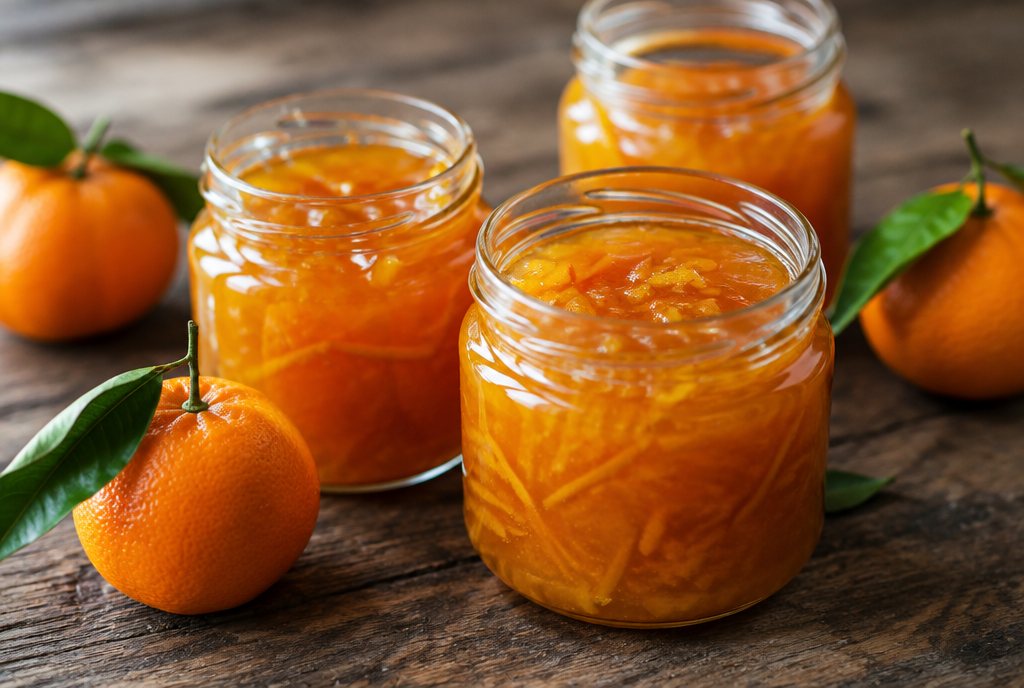
Frozen or in SO₂: which semi-processed mandarin
Mandarins are harvested in a short window during the colder months (see our Calabrian citrus calendar): working with fresh fruit alone squeezes production into a few weeks. Semi-processed fruit lets you spread it across the year.
- Frozen at −18 °C: the most straightforward choice for extra jams and premium ranges, as it goes into the kettle with no additives to manage. It is worth recovering the juice released on thawing.
- In SO₂: it must be desulphited before cooking and the residue in the finished product checked: above 10 mg/kg expressed as SO₂, sulphites must be declared as allergens (Regulation (EU) No 1169/2011). Assess the use of sulphited fruit with your food technologist, also in the light of Regulation (EC) No 1333/2008 on additives.
Dice or irregular quarters
Our Calabrian mandarin is available as 4×4 dice or irregular quarters, frozen or in SO₂; other citrus cuts can be assessed on request. Dice stay recognisable in the jar and spread well in fillings too; quarters suit more rustic marmalades or recipes where the mass is refined after cooking.
What to specify in your request for quotation
- intended product name (marmalade, jam, extra jam);
- cut and preservation: dice or quarters, frozen or in SO₂;
- tolerance for seeds, fibres and membrane residues;
- Brix and acidity of the raw material, to be stated in the data sheet;
- packaging, annual volumes and the seasonality of your sales.
Frequently asked questions
Can I make a mandarin and lemon marmalade?
Yes: lemon is a citrus fruit too and helps with acidity and setting. The exact product name depends on the citrus fruits used.
Can clementines replace mandarins?
Their aroma is similar and they are often seedless, but we process clementines only whole and in SO₂, for candying and syrups. For marmalades and jams our reference semi-processed product is mandarin.
Does frozen mandarin need thawing before cooking?
Not always: some producers load it straight into the kettle, others thaw it in a cold room to manage the juice. Validate it with a processing trial on the first batch.
Need this ingredient for your production?
Tell us product, cut, preservation method and volumes: we’ll reply with the technical data sheet and a tailored quote.