


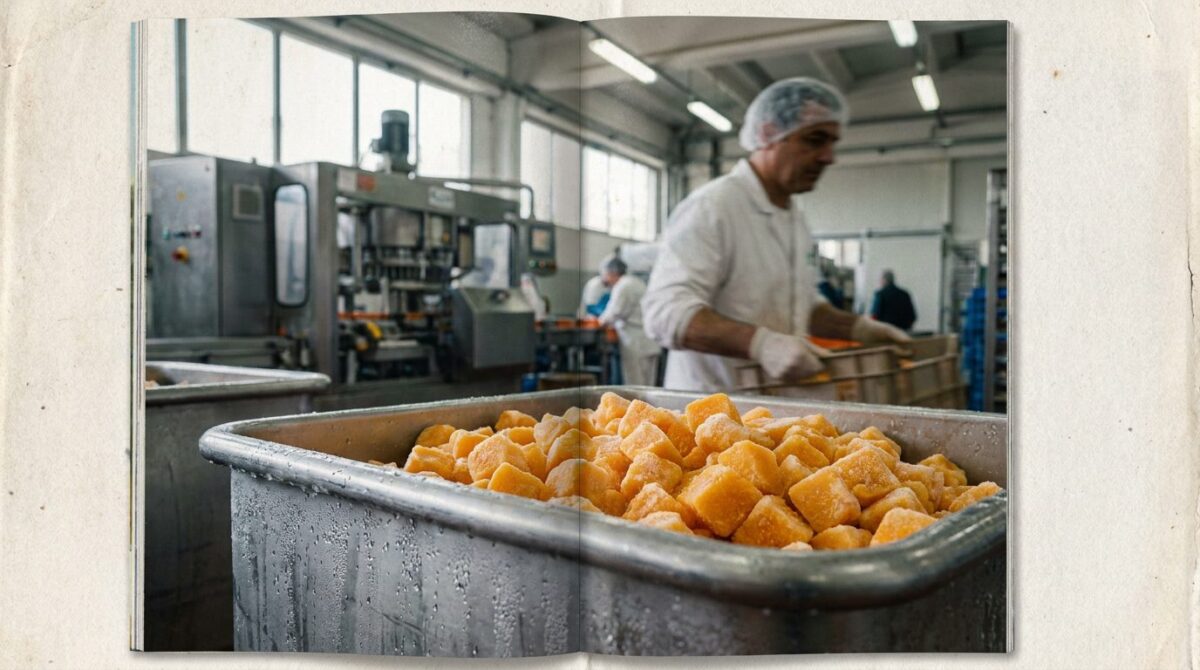
When a producer of juices, industrial artisan ice creams or preserves chooses frozen orange pulp, the difference between one supplier and another is rarely in the price per kilo. It is in the technical details that decide whether the finished product will be consistent batch after batch or not.
The parameters that really matter
The first data to ask a supplier is theBrix degree. For an orange pulp intended for the food industry we expect values between 9 and 13 Brix on the natural product, without added sugars. Below 9 Brix the fruit was picked immature or diluted; above 13 often indicates artificial concentration.
The second parameter is thepH, which for blond Calabrian Navel oranges naturally fluctuates between 3.4 and 4.0. A higher pH may signal dilution or overripe fruit. For a bitter orange (bigarade variety) the pH is lower, around 2.8-3.2.
Crystallization and texture
A quality frozen pulp does not have to showmacroscopic ice crystalswhen opening the carton. The presence of large crystals indicates slow freezing or, worse, a thaw-refreeze cycle during logistics. The result in production is a product that loses water, separates the phases, changes the viscosity.
For those who work in freezing individual pieces (Individual Quick Freezing), the individual pieces must remain separate and fluid, not agglomerated in a single block. This depends on the blast chilling speed in the tunnel (below -30°C in less than 30 minutes) and the relative humidity of the cold chain.
Caliber and homogeneity of cuts
If your process involves cubes, always ask for thedimensional tolerance. A 10 mm cube with a tolerance of ±2 mm is an acceptable standard for industrial pastry making; below 6 mm we speak of ice cream parlor size. Irregular cubes mean irregular yield in the distribution of the fruit in the final mixture.
For pulp intended for juices and nectars, what counts is the homogeneity of the crushing and the absence of peel fragments. The typical industrial threshold is less than 1% fabric weight albedo.
Origin, variety and traceability
A serious supplier specifies the variety (Navel, Tarocco, Moro, Sanguinello) and the district of origin. A “generic orange” pulp from multiple origins is almost always a blend that levels downwards: your final product will not be repeatable.
Ask thecertificate of analysis per batch: must report Brix, pH, total acidity expressed in citric acid, microbiological count and search for residues (pesticides, mycotoxins, heavy metals).
Conservation and logistics
Frozen orange pulp maintains its organoleptic characteristics for 18-24 months at -18°C. Above -15°C a slow degradation of color and aromas begins. Check that your supplier guarantees a certified cold chain until delivery, with temperature recorders in the refrigerated medium.
Request complete technical specificationsof our Navel Tarocco Esterno orange pulp from Calabria.


