


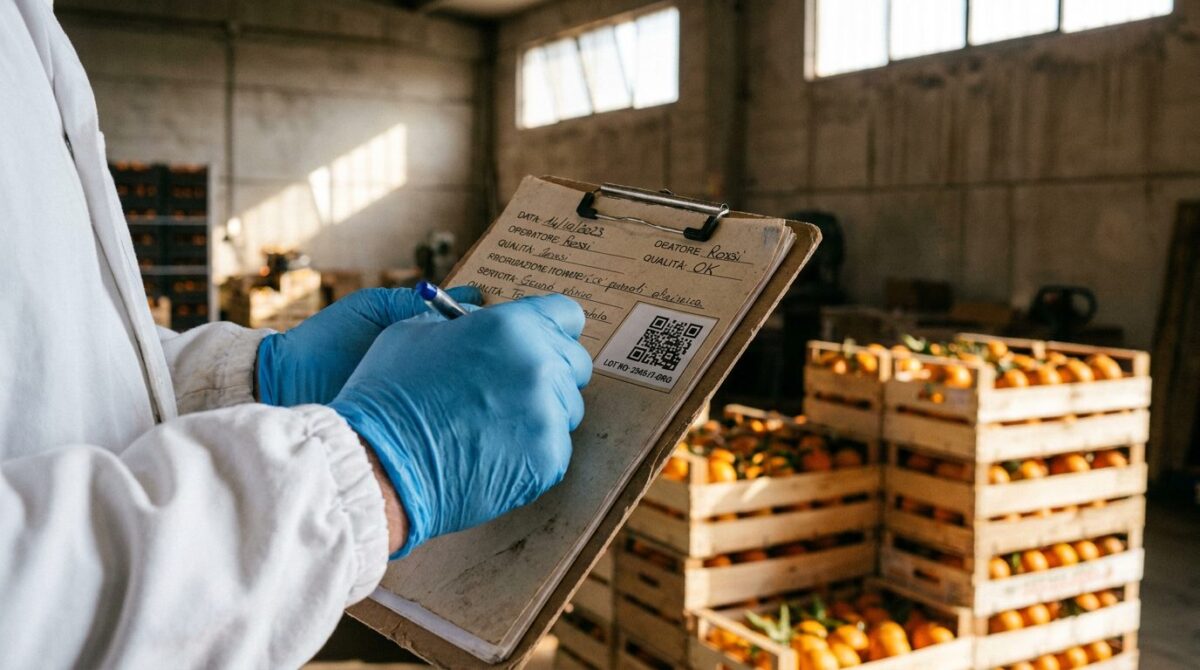
When an industrial buyer signs an annual contract with a supplier of semi-processed fruit products, the first legal and commercial protection he asks for is traceability. It is not enough that it is “on paper”: it must be verifiable, granular and accessible quickly in the event of non-compliance.
What does traceability mean in the fruit supply chain
Traceability is the ability to reconstruct the history of each batch of finished product: who picked the fruit, in which field, on which date, with which phytosanitary treatment, which processing batch it entered, which cell it was stored in, which truck it was shipped on, to whom it was delivered.
EU regulation 178/2002 obliges every operator in the food supply chain to “one step back, one step forward”: every company must know from whom it received and to whom it sold. For industrial semi-processed products this standard is the minimum, but rarely sufficient.
Traceability codes
The batch code is the pivot of the entire system. A typical industrial batch code contains:
- Supplier code(company acronym)
- Product code(e.g. POL-AR-10 for orange pulp 10 mm cubes)
- Production date(YYWWDD or YYYYMMDD format)
- Shift or line acronym
- Progressive number of the day
Example:FGC-POL-AR-260415-M-007means: Far Group Calabria, orange pulp, produced on 15 April 2026, morning shift, seventh batch of the day. It only takes 30 seconds for the supplier’s QC to reconstruct the entire chain back to the field.
What to ask for supplier approval
A robust checklist:
- Supply chain diagram(field → collection center → transformation → warehouse → shipping) with average times for each step.
- List of contributing producerswith field identification codes.
- Country notebook: registration of phytosanitary treatments per plot.
- Computerized traceability system: The supplier must demonstrate that it can respond to a recall in less than 4 hours.
- Batch documentation: certificate of analysis, delivery note, cold storage registration, transport temperature registration.
Certifications that simplify
The certifications that lighten the audit work of the B2B customer:
- GLOBALG.A.P.: standards of good agricultural practices upstream.
- BRC Global Standard for Food Safety: food safety standards at processing plant level.
- IFS Food: German/French equivalent of the BRC, highly requested by European retailers.
- ISO 22000: integrated food safety management system.
- Organic (EU 2018/848): for those who sell organic finished products.
- PDO/PGI: for territorially certified varieties.
Second party audit
A serious industrial buyer doesn’t just trust third-party certifications. Plan at least oneannual auditin the factory for:
- Check the status of the processing lines.
- Inspect cold rooms and temperature recorders.
- Examine the HACCP log and non-compliance records.
- See the field notebooks of the contributing producers.
What to do in case of non-compliance
The supplier must have a written procedure for managing non-conformities: how it blocks a suspect batch, how it notifies the customer, how long it takes to rebuild the chain, how it manages product recalls. A good supplier will show you this procedure before you even ask.
Traceability is not bureaucracy. It’s the way buyers sleep at night.
Discover our supply chain policyand the control systems that we apply from the field to the pallet.


